
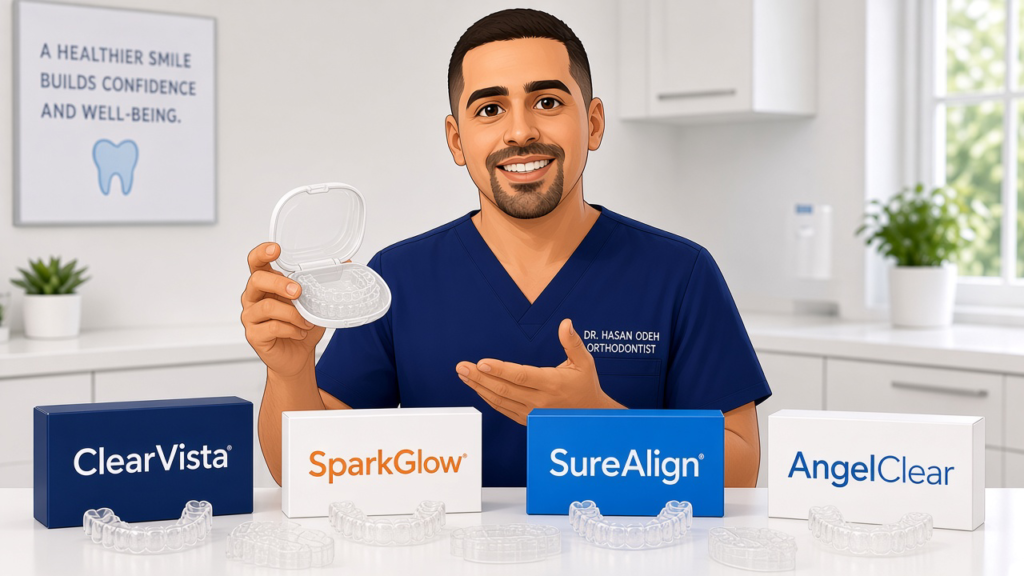
Invisalign, Spark, SureSmile or Angel Aligner? Why the Brand Matters Less Than Your Orthodontist
“I would like Invisalign.” It is the sentence I hear most often in my consultations in Dubai and Abu Dhabi. And when I explain that I now treat with a different clear aligner system, the next question is usually a worried one: “Is it the same thing?”
It is a fair question, and it deserves a straight answer. Let me explain how clear aligners really work, why the brand name is only part of the story, and why I made the choices I did.
Invisalign Is a Brand. Clear Aligner Therapy Is the Treatment.
Invisalign was the first clear aligner system to reach the mainstream, and it did so many years before anyone else. It earned that fame honestly. But being first has a side effect: the brand name became the word people use for the whole treatment.
It is the same thing that happened with other household names. People ask for a “Hoover” when they want a vacuum cleaner, or a “Jacuzzi” when they mean a hot tub. In the same way, many patients say “Invisalign” when what they actually mean is clear aligner therapy: a series of custom-made, removable, transparent trays that move teeth gradually.
Today there are several well-established clear aligner systems in the world, from different manufacturers, built on the same basic principle. They differ in materials, software, and extra features. What they share is more important than what separates them.
Clear aligners are the treatment. Invisalign, Spark, SureSmile and Angel Aligner are different brands of the tool. The result you get depends far more on who plans your treatment than on the name printed on the box.
My Own Experience With Different Systems
I have not chosen my aligner system casually. Over my career I have treated hundreds of patients with Invisalign, then with SureSmile for several years, and more recently I moved to Angel Aligner.
I did not make those changes because one system “works” and another does not. I made them because, as technology develops, I look for the system that gives me the best control for my patients’ cases. A good orthodontist should keep evaluating their tools, in the same way a surgeon keeps evaluating their instruments.
The Brand Is the Tool. The Planning Is the Skill.
A digital aligner plan is a series of tooth movements designed step by step: which teeth move, in what order, by how much, with what supports. The software helps, but the decisions behind that plan are clinical ones:
- Is this case suitable for aligners at all, or would braces serve the patient better?
- Which teeth should be moved first, and which should stay anchored?
- Is there enough room, or is space creation or extraction part of the plan?
- How will the bite be corrected, and how will the roots be controlled?
- What happens if the teeth do not respond exactly as the software predicted?
These questions are answered by the orthodontist, not the brand. A sophisticated system in inexperienced hands can produce a poor result. A well-planned case with any good system, in experienced hands, can produce an excellent one.
Think of it as a pilot and an aircraft. The aircraft matters. But nobody chooses a pilot by the logo on the plane.
Why I Chose Angel Aligner
Angel Aligner is not a newcomer. The company was founded in 2003, has been publicly listed since 2021, and provides clear aligner solutions to clinicians in more than 60 countries. It has grown into one of the largest clear aligner companies in the world. The features that convinced me are practical and clinical ones.
1. Built-in Angel Buttons (angelButton)
Many aligner cases need elastics to correct the bite, close spaces, or move molars. Traditionally, this means bonding small attachments or cutting the aligner, which can weaken it and weaken force delivery.
Angel Aligner built these anchor points directly into the aligner during manufacturing. The feature was introduced in 2019, and it can be positioned where the case needs it. For the patient, that means fewer chair-side steps, fewer emergency visits caused by bonded buttons coming off, and a more reliable platform for elastic-based movements.
2. A6 Mandibular Advancement for Growing Teens
Teenagers are one of the most important groups in orthodontics, because growth can be used to help correct a bite. Angel’s A6 Mandibular Advancement feature, which has been on the market since 2015, is designed to guide the lower jaw forward in Class II cases, working in a similar way to traditional twin block appliances, but within a clear aligner.
For the right teenager, it means correcting the bite without a bulky fixed or removable functional appliance. It is a clinical tool that needs careful case selection and monitoring, and I assess every teenager individually before recommending it.
3. A Platform Built for Complex Cases
Angel has continued to develop features such as angelHook for elastic use in younger patients, a root-control system, and a digital planning platform. What I value is that they are designed by clinicians for clinicians, and they give me more precise ways to plan and control tooth movement.
Choosing a system is a clinical decision, and I make it for one reason: it gives me the control I want over my patients’ treatment.
Common Questions I Hear
“Is Angel Aligner as good as Invisalign?”
Both are established systems used by orthodontists worldwide. The honest answer is that the quality of your result depends mostly on diagnosis, planning, and follow-up. That is where I put my time and experience.
“Will my treatment look or feel different?”
Day to day, no. The aligners are clear, removable, and worn 20–22 hours a day in the same way. You will clean them and carry them in the same way. What differs is behind the scenes, in the software and features I use to plan your case.
“Can I insist on a particular brand?”
You are always welcome to ask, and I will explain my reasoning openly. But I would encourage you to judge a provider by their diagnosis, records, and planning rather than by the logo.
“Does the brand change the treatment time?”
Treatment time depends on your case and on your compliance, above all on wearing your aligners as instructed. No brand removes the need for that.
What to Look For When Choosing an Aligner Provider
| Factor | Why it matters | Question to ask |
|---|---|---|
| Who plans the case | Tooth movements are designed by the clinician, not the brand | Will you personally plan and review my digital setup? |
| Diagnosis and records | Aligners cannot fix what has not been diagnosed | Will I have X-rays, photos and a scan before treatment? |
| Training and experience | Complex cases need biomechanical judgement | Are you a specialist orthodontist? How many aligner cases have you treated? |
| Monitoring | Plans need adjusting as teeth respond | How often will you see me, and who checks my progress? |
| Refinements | Most cases need fine-tuning at the end | Are refinements included in the fee? |
| The brand | A good tool, in good hands | Why do you use this system? |
If a provider can only talk about the brand and cannot explain the plan for your teeth, that is the moment to ask more questions.
Book a Clear Aligner Consultation
If you are considering clear aligners in Dubai or Abu Dhabi, I would be glad to examine you, take proper records, and give you an honest assessment of whether aligners are right for your case and what the plan would look like. I see patients at Gemini Medical Center, Al Safa, Dubai and Palmira Specialized Medical Center, Abu Dhabi.
📲 Book via WhatsApp or use the appointment form on this website.