
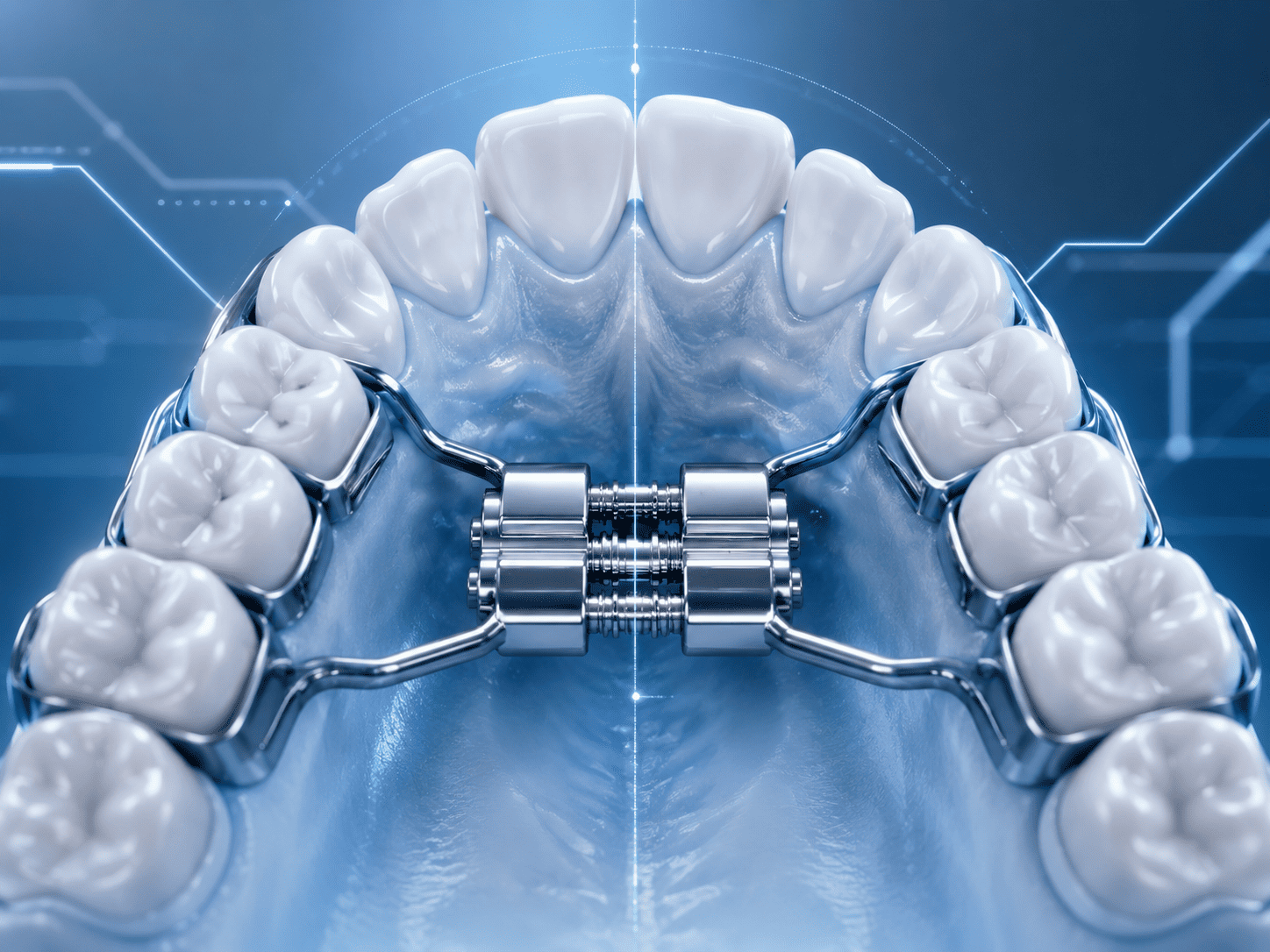
MARPE — Miniscrew-Assisted Rapid Palatal Expansion — is a specialised orthodontic procedure that uses mini-screws anchored in the palate to apply controlled expansion forces directly to the bones of the upper jaw, bypassing the teeth. Until relatively recently, expanding the palate in adults required jaw surgery. MARPE has changed that for many patients — making genuine skeletal expansion possible in adults without a surgical procedure.
Dr. Hasan Odeh offers MARPE treatment in Dubai at Gemini Medical Center in Al Safa. This is a complex, high-precision procedure requiring specialist orthodontic training and careful patient selection. Not every patient with a narrow palate is a candidate — but for those who are, MARPE can achieve results that no other non-surgical approach can replicate.
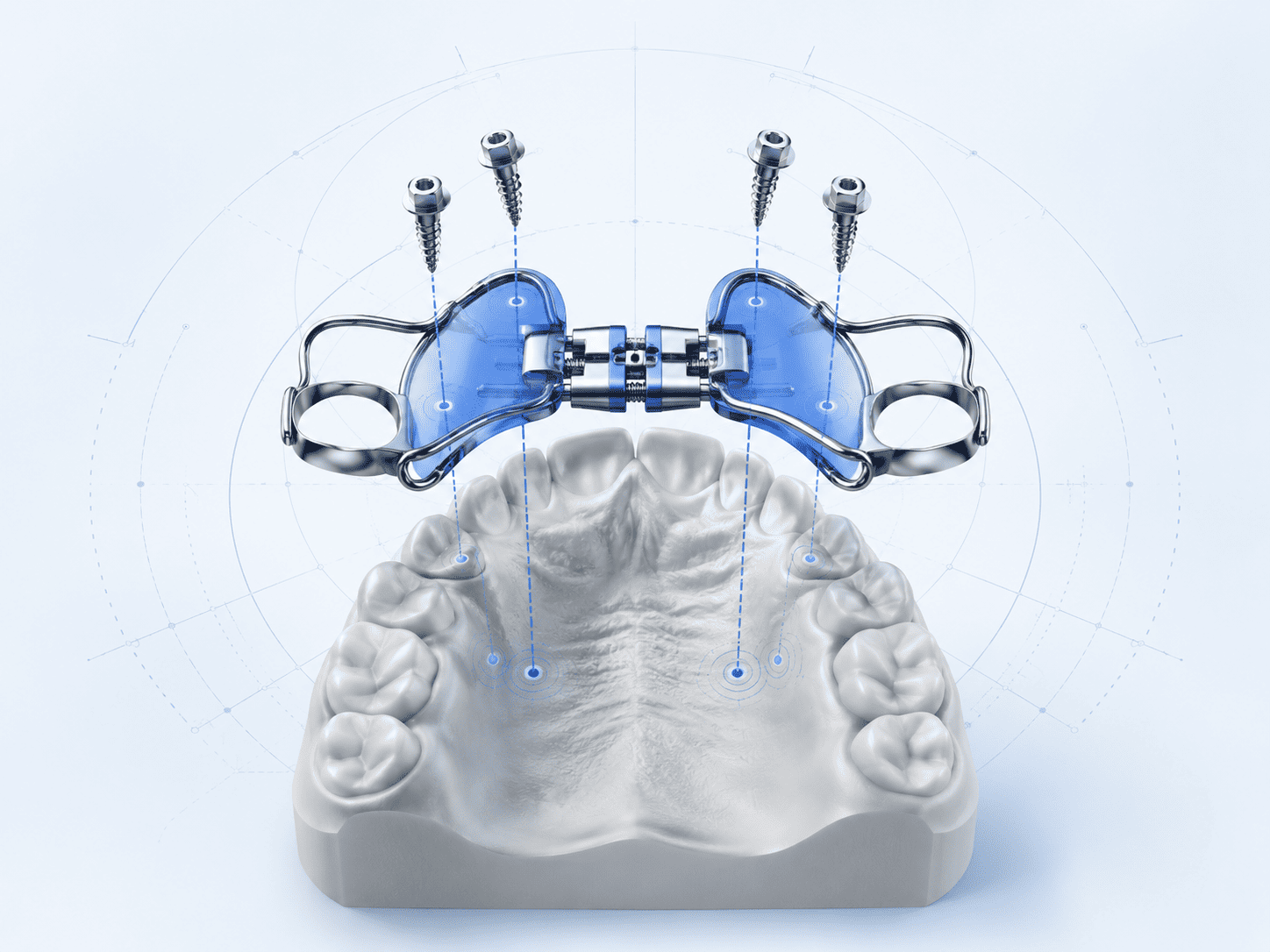
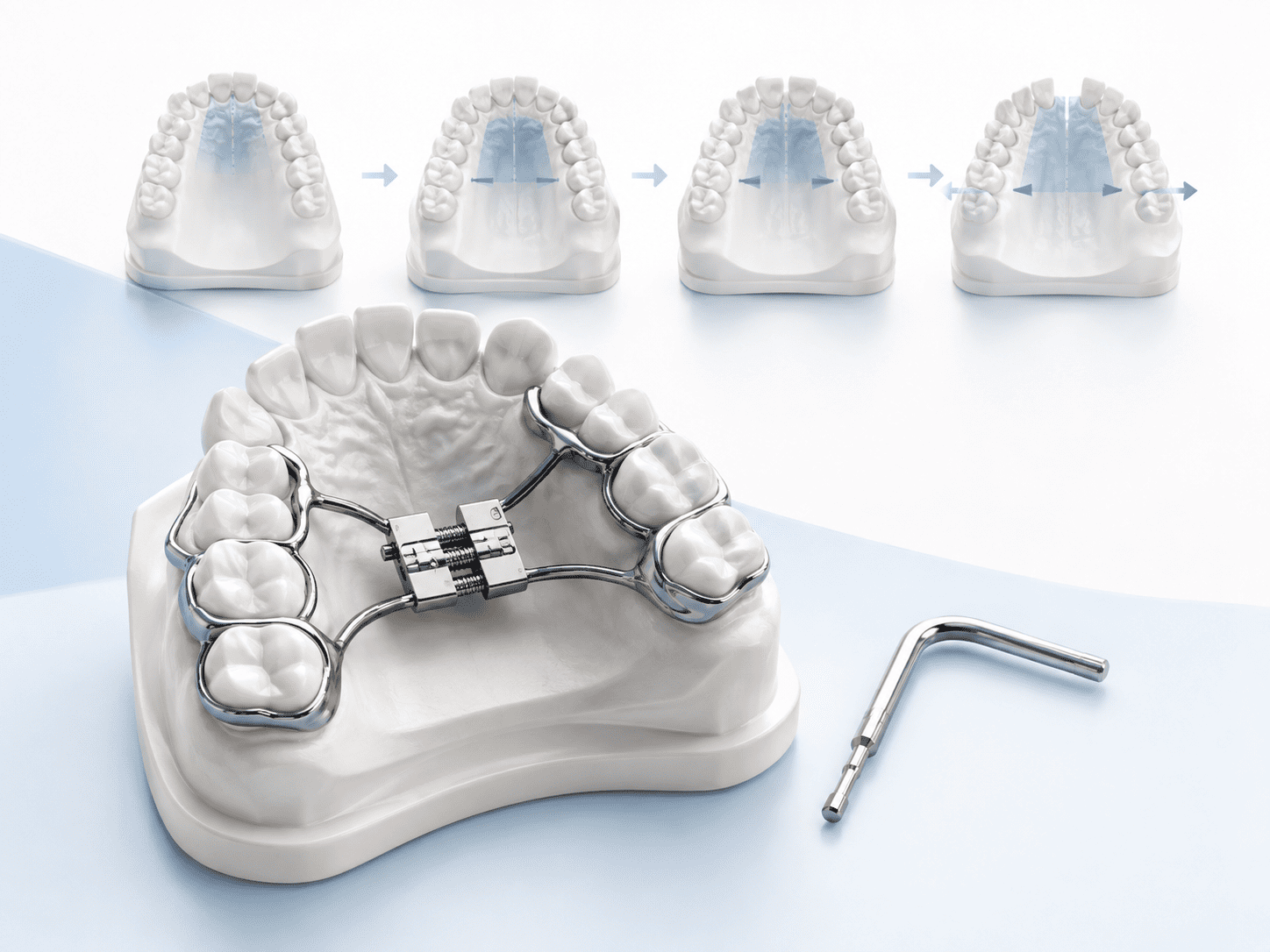
MARPE stands for Miniscrew-Assisted Rapid Palatal Expansion. It is an orthodontic appliance — a palatal expander supported by four titanium mini-screws (also called miniscrews, micro-implants, or TADs — temporary anchorage devices) that are placed directly into the bone of the palate.
In children, the palatal suture — the joint running down the centre of the upper jaw — is open and responsive to expansion forces applied through the teeth. A conventional palatal expander works well in this age group. In adults, this suture has fused, meaning that conventional expanders applying force through the teeth produce tooth movement rather than genuine bone expansion, and can cause teeth to tip outward without the underlying jaw actually widening.
MARPE bypasses this problem by anchoring directly into the bone via mini-screws, applying the expansion force to the skeletal structure rather than through the teeth. This enables genuine palatal suture separation — true widening of the upper jaw — in patients where the suture is still partially responsive to force. Clinical studies show MARPE can achieve skeletal expansion in adults up to their mid-30s and in some patients beyond, though success rates decrease with age as the suture becomes progressively more fused.
MARPE is also referred to as MSE (Maxillary Skeletal Expander), EASE (Effective Arch Skeletal Expansion), or simply micro-implant assisted palatal expansion. The underlying principle is the same across these systems.
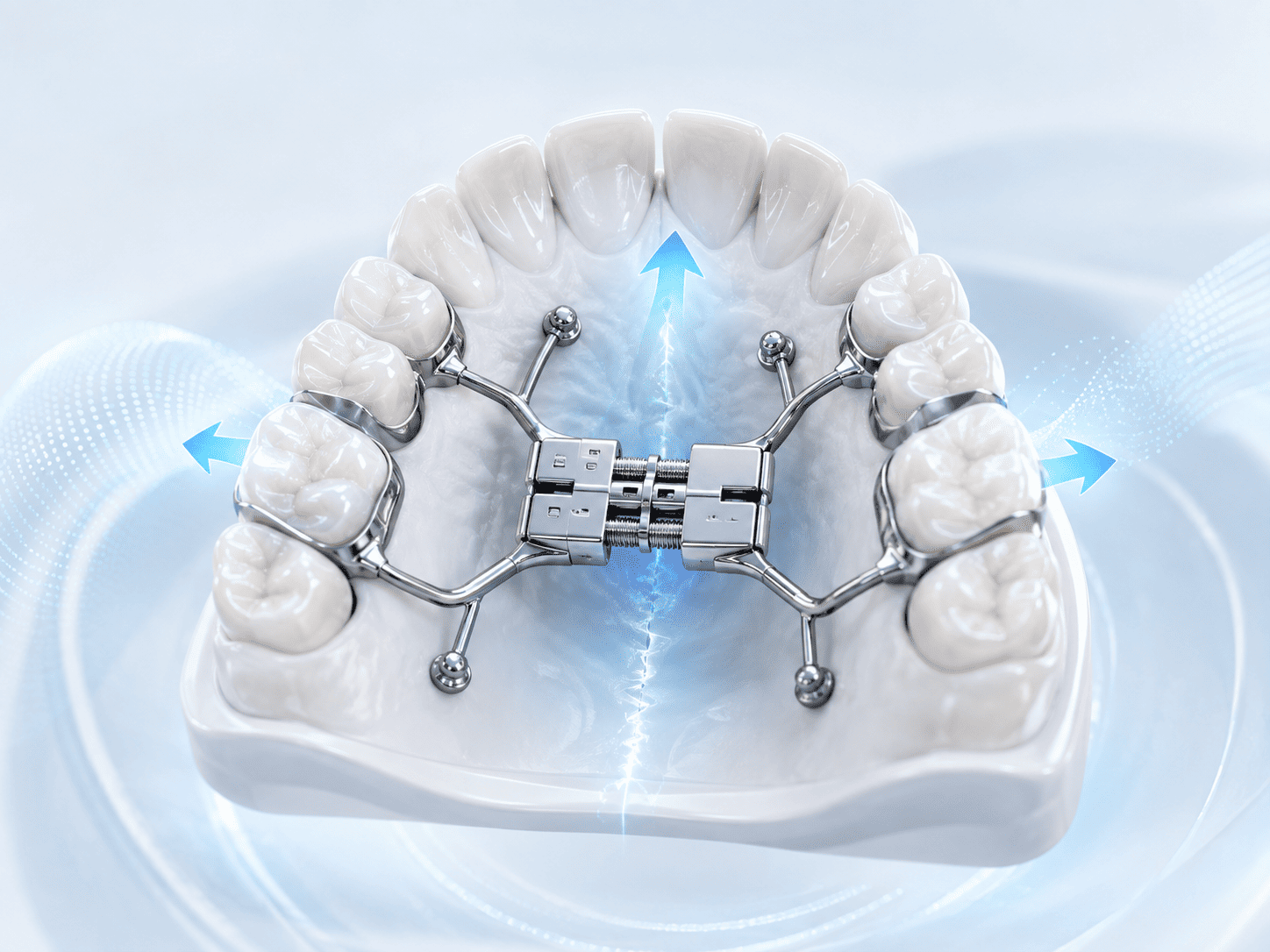
MARPE is indicated for adults with a genuinely narrow upper jaw (maxillary constriction) where the palate has fused and conventional expanders are no longer effective. The procedure addresses the underlying skeletal problem — not just the tooth position.
A CBCT (cone beam CT) scan is essential before MARPE treatment — it allows Dr. Hasan to assess the palatal suture maturation, bone quality at the miniscrew sites, and whether skeletal expansion is achievable for the specific patient. MARPE cannot be correctly planned from standard X-rays alone.
| MARPE (Non-Surgical) | SARPE (Surgical Expansion) | |
|---|---|---|
| Procedure | Orthodontic appliance + mini-screws placed in-clinic | Surgical osteotomy of the palate + expander |
| Anaesthesia | Local anaesthesia for miniscrew placement | General anaesthesia |
| Expansion Achieved | True skeletal expansion in suitable candidates | True skeletal expansion in all patients |
| Success Rate | High in younger adults; decreases with suture maturity | High regardless of suture maturity |
| Recovery | Mild discomfort; no surgical recovery | Surgical recovery period |
| Best for | Adults up to mid-30s with partially responsive suture | Adults where MARPE is not achievable, or where surgery is already planned |
| Cost | Typically lower than surgical option | Higher — includes surgical fees |
Palatal expansion without surgery: MARPE makes this achievable for many adults who previously had no non-surgical option. Whether MARPE or SARPE is more appropriate depends on the degree of suture maturation assessed on CBCT — which is why imaging is the essential first step.
A conventional palatal expander — the type used routinely in children — pushes against the teeth to apply expansion force. In adults with a fused suture, this produces tooth tipping and dental expansion rather than skeletal expansion, and can cause the roots of the upper back teeth to approach the outer bone boundary (dehiscence risk). MARPE bypasses the teeth entirely by anchoring directly in the bone, making it the only non-surgical route to true skeletal expansion in adults.
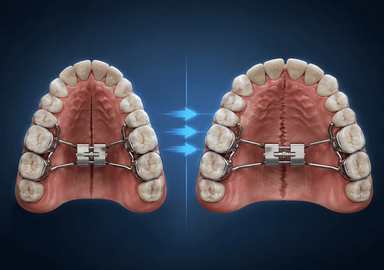
MARPE before and after results show widening of the upper dental arch and correction of the crossbite. A characteristic early sign of successful MARPE expansion is the appearance of a temporary gap between the upper front two teeth (a midline diastema) — this opening indicates that the palatal suture is genuinely separating, which is the evidence that skeletal expansion is occurring. This gap closes naturally over the retention period as the suture fills in with new bone.
The full result of MARPE treatment — after the expansion phase, retention period, and subsequent orthodontic treatment — typically shows a broader, more stable arch with corrected crossbite and improved alignment. Airway improvement, where it occurs, is not visible in dental photographs but can be measured on imaging and reported by patients in improved nasal breathing.
The MARPE phase itself (expansion + retention) typically takes 9–12 months. This is followed by full orthodontic treatment, typically 18–24 months. Total treatment from MARPE start to end of orthodontic treatment is usually 2–3 years. Results are stable when treatment is completed correctly and retainers are worn as instructed.
The most direct indication. Widening the upper jaw brings the upper back teeth into correct alignment over the lower teeth.
Expansion can create the space needed to align crowded upper teeth without extractions, as a precursor to fixed brace treatment.
The palate forms the floor of the nasal cavity. Widening it increases the width of the nasal airway, which can improve nasal breathing and reduce mouth breathing. Some patients with mild obstructive sleep apnoea or nasal obstruction see meaningful improvement.
A narrow upper jaw can give the mid-face a compressed appearance. Expansion can improve facial width and the upper lip support in appropriate cases.
For patients who are suitable candidates, MARPE avoids the recovery, cost, and risk of surgical palatal expansion (SARPE).
MARPE is typically followed by a period of retention, then full orthodontic treatment (braces or aligners) to align the teeth in the newly expanded arch.
How long does metal braces take to straighten teeth? Average treatment time is 18–24 months for most cases. Simpler cases can complete in 12–18 months; complex bite corrections involving jaw discrepancy may take longer. Dr. Hasan gives a realistic timeline at consultation — not an optimistic estimate designed to start treatment
MARPE stands for Miniscrew-Assisted Rapid Palatal Expansion. It is a specialist orthodontic procedure that uses four titanium mini-screws anchored in the palate to apply expansion forces directly to the bones of the upper jaw, enabling true skeletal expansion in adults. Until MARPE, adults with a fused palate typically required jaw surgery to achieve this result.
Yes — MARPE makes non-surgical palatal expansion achievable for many adults who were previously told surgery (SARPE) was their only option. Whether a specific patient is suitable depends on the degree of palatal suture maturation, which is assessed on CBCT imaging. Success rates are highest in younger adults and decrease as the suture becomes progressively more fused with age.
In children, the palatal suture is open and responsive to expansion forces applied through the teeth via a conventional expander. In adults, the suture has fused — conventional expanders push against the teeth but the bone doesn't separate, causing tooth tipping rather than skeletal expansion. MARPE bypasses the teeth by anchoring directly in the bone, making true skeletal expansion achievable.
Both achieve true skeletal palatal expansion. MARPE is non-surgical — the mini-screws are placed under local anaesthesia in an orthodontic setting. SARPE (Surgically Assisted Rapid Palatal Expansion) involves a surgical procedure under general anaesthesia to cut the palatal bone before expansion. MARPE is appropriate for patients where the suture is still partially responsive; SARPE is the option when MARPE is not achievable or additional surgery is already planned.
The mini-screw placement procedure is performed under local anaesthesia and is not painful during the procedure. Mild soreness and pressure for 1–3 days after placement is expected and managed with standard over-the-counter pain relief. During the active expansion phase, patients typically feel pressure in the palate and sometimes the nose after each activation — this is normal and settles within minutes. Patients adapt to the appliance within the first week.
Yes — a midline gap (diastema) between the upper front teeth typically appears during active expansion. This is a positive sign — it indicates that the palatal suture is genuinely separating (skeletal expansion is occurring). The gap closes naturally during the retention phase as new bone fills in the widened suture. Dr. Hasan will explain this to you before treatment so it is expected and understood.
The MARPE expansion and retention phase typically takes 9–12 months. This is followed by full orthodontic treatment (braces or aligners) for 18–24 months. Total treatment from MARPE start to end of orthodontic care is typically 2–3 years.
Widening the upper jaw widens the floor of the nasal cavity, which can meaningfully improve nasal airflow in patients whose nasal obstruction is related to palatal narrowness. Some patients with mild obstructive sleep apnoea also report improvement. The extent of airway benefit varies between patients and cannot be guaranteed — it depends on the degree of nasal obstruction and its specific cause.
Yes, in almost all cases. MARPE creates the correct arch width; orthodontic treatment (braces or clear aligners) is then needed to align the teeth within that corrected arch. MARPE and subsequent orthodontic treatment are planned together as an integrated treatment sequence.
Yes — a CBCT (cone beam CT) is essential before MARPE. It allows Dr. Hasan to assess the maturation of the palatal suture (to determine if skeletal expansion is achievable), the bone quality and quantity at the miniscrew placement sites, and the precise anatomy of the palate. MARPE cannot be safely or predictably planned from standard X-rays alone.
Yes — Dr. Hasan Odeh offers MARPE treatment at Gemini Medical Center in Al Safa, Dubai. MARPE is a specialist procedure requiring advanced orthodontic training and CBCT assessment. If you have been told you need palatal expansion and are an adult, a consultation with Dr. Hasan can determine whether MARPE is an appropriate non-surgical option for your case.
MARPE is not a routine orthodontic procedure. It requires specialist training, CBCT-guided planning, precise miniscrew placement, and careful monitoring throughout the expansion and retention phases. Patient selection is critical — recommending MARPE for a patient who is not a suitable candidate, or failing to identify that SARPE is needed instead, leads to predictably poor outcomes. The clinical decision-making involved requires genuine specialist orthodontic expertise.
If you have been told you have a narrow upper jaw, a crossbite, or that palatal expansion is needed — and you are an adult — a consultation with Dr. Hasan will determine whether MARPE is an appropriate non-surgical option for your case. The assessment includes a clinical examination and, where indicated, a CBCT to evaluate palatal suture maturation and plan treatment precisely.

The goal of our clinic is to provide friendly, expert orthodontic care for patients of all ages — from young children receiving their first orthodontic assessment to adults discovering that the right time for treatment is now.
Copyright © 2026 Rights Reserved. Website by TDMA
WhatsApp us